
Saltwater Pool Maintenance
 Written byFilip De Weer — CE0October 15, 2026
Reviewed by: Leisure Pools Technical Team
Last reviewed: October 15, 2026
Saltwater Pool Maintenance: salt levels, pH, free chlorine, filtration, the salt cell, cloudy water fixes and simple routine care.
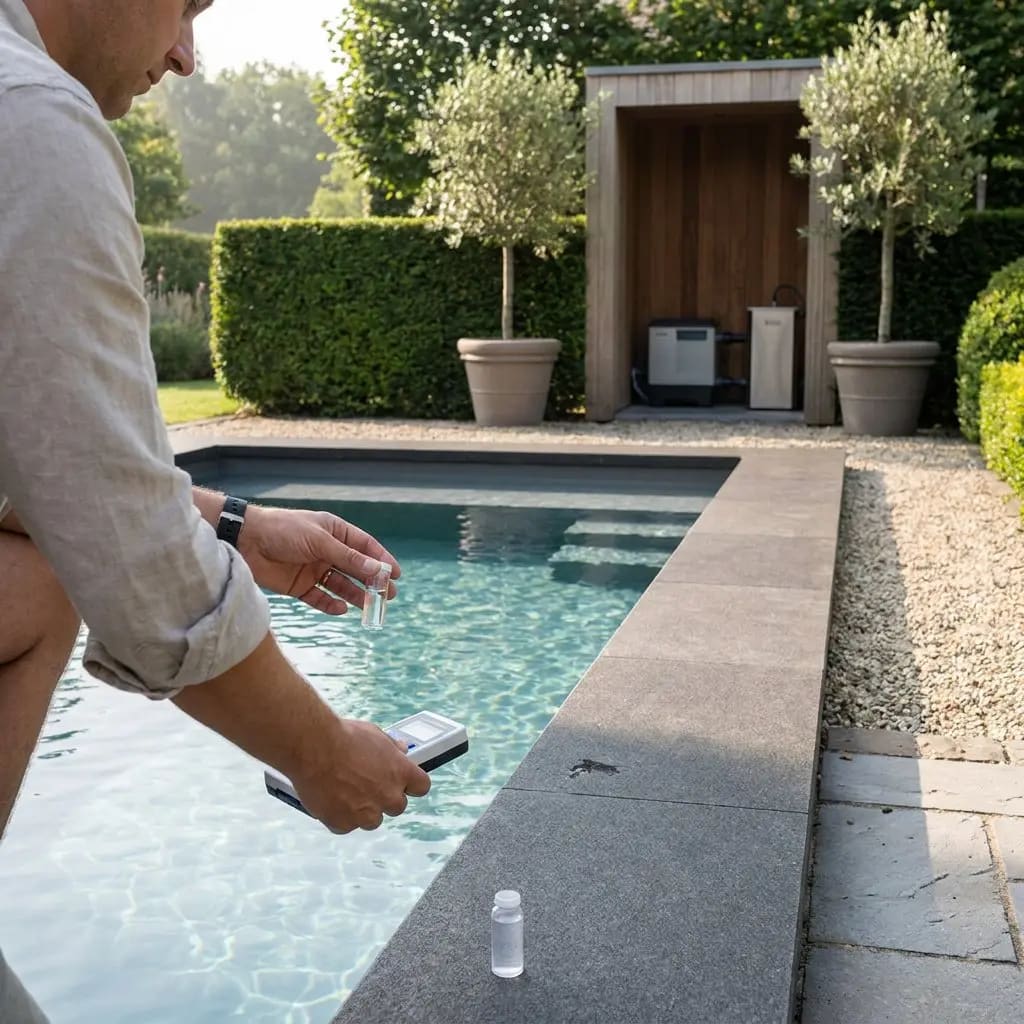
A saltwater pool usually requires fewer day-to-day tasks than a traditional chlorine pool, but maintenance remains essential. Clear, hygienic water depends mainly on four things: the right salt level, a stable pH, enough free chlorine and good filtration. As soon as one of those parts gets out of balance, you will quickly notice it in cloudy water, algae growth or a system that works less efficiently.
If you already have a pool, you mainly want to know what to check and when. If you are still considering buying a saltwater pool, you want to know whether maintenance really is easier. In both cases, the same applies: a good salt system takes work off your hands, but it does not replace water testing.
Which water levels should you test?
When it comes to saltwater pool maintenance, everything depends on testing, not guessing. A salt system converts dissolved salt into active chlorine through electrolysis. That chlorine disinfects the water and then becomes part of the salt cycle again. That is why, in a saltwater pool, you should not only check the salt level, but also measure chlorine in the saltwater pool. Salt alone does not keep the water clean.
Treat the values below as guidelines. The exact ideal range can vary slightly by unit and pool type.
If you notice the pH often rises, that is not unusual with salt chlorination. Regular adjustment is therefore a normal part of maintenance.
Filtration, run time and cleaning the electrolysis cell
A saltwater system only works properly if the water circulates enough. The cell must therefore always work together with the filtration system, never separately from it. A dirty filter or run time that is too short means the system may be running, yet still not disinfecting enough.
How long should the saltwater system run?
There is no universal number of hours that is right for every pool. A commonly used guideline is to align the daily filtration time roughly with the water temperature divided by two. At 28°C, that works out to about 14 hours of filtration per day. Treat that as a starting point, not a guarantee. With lots of sun, lots of swimmers or hot weather, the system often needs to run longer.
How to clean the salt cell
Ideally, you should check the electrolysis cell every 1 to 3 months, especially in hard water areas. Many modern cells have a self-cleaning function, but a visual check remains important.
- Turn off the pump and power.
- Remove the cell according to the manufacturer's manual.
- Check for limescale, white deposits and dirt.
- Rinse with water first. Only use a suitable cleaner or a mild acidic solution if the manufacturer allows it.
- Do not use hard metal objects to scrape off deposits.
- Rinse again and put everything back correctly.
Cleaning too aggressively too often is not better. It can damage the coating on the plates and shorten the life of the cell.
When do you need to add salt?
Pool salt is not used up like chlorine tablets. In a properly working system, it largely remains in the water cycle. Topping up salt is mainly necessary after water loss or dilution, for example after backwashing, a leak, lots of splash-out, partial water replacement or heavy rain combined with overflow and topping up the water.
Never top up blindly. Measure the salt level first and then add, in stages, only what is really needed. That prevents you from overshooting and later having to replace water to lower the concentration again.
Which salt should you use?
Ideally, use pure pool salt that is suitable for salt chlorination. Table salt or salt with extra additives, anti-caking agents or iodine is not a good choice. Pure pool salt dissolves better and gives less risk of unwanted deposits or malfunctions.
Common problems and quick fixes
Cloudy or green water
First check pH, free chlorine, the filter and run time. Cloudy or green water is often caused by too little effective disinfection, insufficient circulation or a dirty cell. Clean the filter and pool, temporarily increase filtration if needed and bring the water levels back within the guidelines. For stubborn algae, an additional corrective treatment may be needed according to the instructions for your system and water treatment products.
Too little chlorine despite enough salt
Then the problem usually is not the salt level alone. Look for pH that is too high, scaled electrolysis plates, run time that is too short or poor flow. Also check whether the cell is actually producing and whether the pump is running long enough during warm periods.
Salt level too high or too low
If the level is too low, add pool salt in stages and test again once it has fully dissolved. If the level is too high, the only solution is dilution by replacing part of the water. Adding more salt because the water does not look right is almost never the right first step.
What should you consider if you are still thinking about a saltwater pool?
For many people, a saltwater pool is appealing because day-to-day maintenance becomes easier to manage. You do not have to keep adding chlorine manually, and swimming comfort is often experienced as more pleasant. At the same time, a saltwater pool is not maintenance-free. You still need water analysis, pH correction, filtration and cleaning of the electrolysis cell. So if you are buying a pool, it is wise to look not only at comfort, but also at a proper installation, correct sizing and materials that are suitable for use with salt.
Frequently asked questions
How do you maintain a saltwater pool in short?
Test pH and free chlorine weekly, measure the salt level monthly, keep the filter and skimmer clean, let the system run long enough and check the electrolysis cell regularly for limescale and dirt.
How often should you turn on a saltwater system?
The system runs together with the filtration. In summer, that is often daily for several hours, depending on temperature, use and sun exposure. The right run time varies by pool and system.
How do I clean my salt cell?
Switch off the system, remove the cell according to the manual, check for limescale and clean carefully with water and only approved cleaning agents. Avoid aggressive scraping or cleaning with acid too often.
How often should I top up salt?
Only when testing shows that the salt level is too low. Usually that is after water loss, backwashing, partial water replacement or dilution of the pool water.
Does this also apply to saltwater hot tub maintenance?
The basics are similar, but a saltwater hot tub usually needs even tighter control. Because of the smaller water volume and higher temperature, pH and disinfection fluctuate more quickly, which makes more frequent testing important.

Ready to start building your dream swimming pool?


