
Pool Pump Maintenance
 Written byFilip De Weer — CE0October 15, 2026
Reviewed by: Leisure Pools Technical Team
Last reviewed: October 15, 2026
Pool Pump Maintenance: clean baskets, check the filter, set run time, spot faults early and winterise for longer service life.
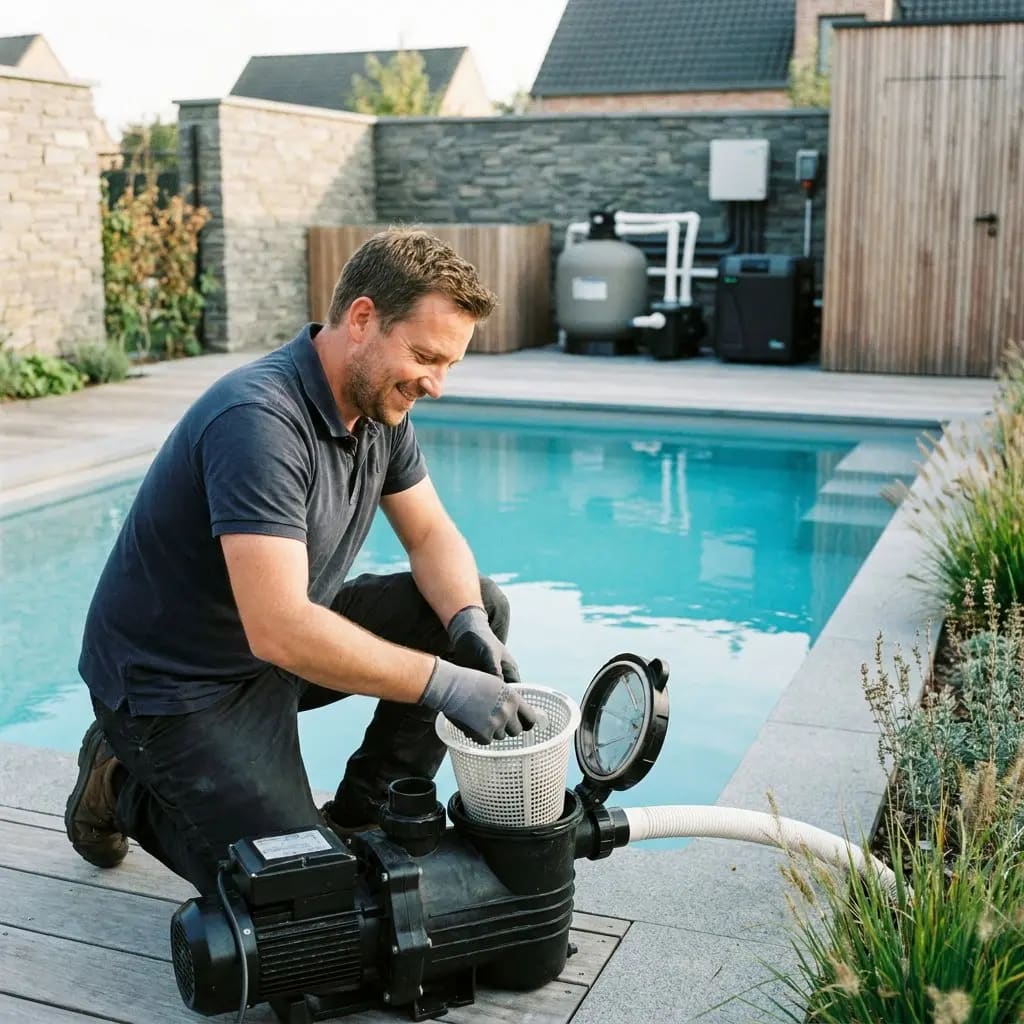
Proper swimming pool pump maintenance prevents cloudy water, noise, reduced flow and unnecessary wear. The basics are simple: keep the baskets and filter clean, do not let the pump run dry, check for air leaks and match the run time to the pool volume, temperature and use. That matters not only if you already have a pool. Anyone planning to buy a pool can also save themselves a lot of maintenance later by choosing a well-matched system from the start.
What you need to check regularly
A fixed inspection routine prevents most issues before they turn into faults. With practical maintenance tips for your pool, it is easier to stick to that routine.
Keep the pump basket and skimmer basket clean above all. A full basket increases resistance, reduces the flow rate and puts extra strain on the motor. Also check that the transparent lid seals properly and that the O-ring stays clean and flexible.
In addition, the suction side needs to be airtight. Even a small leak in a coupling or hose can quickly draw in air, making the pool pump difficult to prime or causing it to lose prime. Also make sure there is enough ventilation around the motor so heat can dissipate properly.
The right run time is part of maintenance
Maintenance is not only about cleaning, but also about correct use. A pump that runs too little allows dirt to settle and puts more strain on water treatment. A pump that runs longer than necessary uses more energy and can run hotter than it needs to. If you want to plan efficiently, it is also worth looking at how saving energy with your pool system can be combined with sufficient circulation. As a practical guideline, you want the full water volume to circulate regularly, often within about 4 to 6 hours per cycle. On hot summer days, in many situations that works out at around 8 to 12 hours of pump run time per day, spread across the warmest hours. If you are still choosing a pool, look not only at pump power, but above all at the combination of pump, filter and pipework.
Common faults you can check yourself first
Always switch off the power first. If the motor is very hot, you smell burning electrics or the same fault keeps coming back, have the pump inspected.
The pool pump won't prime
- Check whether the water level is high enough.
- Fill the strainer housing with water and close the lid properly.
- Check couplings, hoses and seals for air leaks.
- Check whether the skimmer, basket or suction line is blocked.
- With long or unfavourable pipe runs, the resistance may be too high.
When a pump will not prime, the cause is usually on the suction side and much less often in the filter tank itself. In practice, what seems to be a faulty pump often turns out to be a combination of an air leak, a blockage or too much resistance in the pipework.
The pump hums or buzzes
- Check whether the impeller is jammed by dirt, limescale or a small object.
- Listen for whether the motor only hums but does not really come up to speed.
- On older pumps, a worn capacitor can prevent starting.
- Check whether the shaft can turn freely according to the manual.
A humming motor does not automatically mean the whole pump is worn out. Sometimes only the impeller is stuck. If the resistance remains high or the motor keeps cutting out, the problem is no longer maintenance but repair.
The flow rate drops noticeably
First check the simple causes: full baskets, a dirty cartridge filter, a sand filter that needs backwashing, half-closed valves or a water level that is too low. Especially with smaller pools and above-ground pools, weak circulation is quickly mistaken for a faulty pump, while the problem often lies in the filter or suction side.
Filter maintenance by system type
The pump and the filter work together. That is why cleaning and maintaining pool filters should always be part of pool pump maintenance.
Sand filter pump
Backwash a sand filter as soon as the pressure rises or the flow rate drops noticeably. Do not wait until the water has already turned cloudy. Filter sand wears over time and then filters less efficiently, so replacement every few years is common. Glass media often last longer, while filter balls require extra manual cleaning.
Cartridge filter pump
Clean a cartridge filter regularly during the season, especially in warm weather or with heavy use. Rinse the cartridge as soon as the flow rate drops. If circulation no longer recovers properly, or the material is hard, frayed or discoloured, replacement is usually the best choice.
Extra attention for a pool pump with a saltwater system
A pool pump used with a saltwater system requires the right choice of materials and stable flow. Watch for salt deposits around couplings and metal parts, keep the salt level within the recommended values and check whether the flow rate matches the electrolysis cell. Not every pump is automatically ideal for a saltwater system, especially if heating or extra water treatment is also connected.
Winterising and extending service life
Before winter, clean the baskets and filter, drain water from the pump housing and pipework, and store removable pumps in a frost-free place. With fixed installations, open the drain plugs according to the manual so that no water can freeze inside the housing. In spring, first check the seals, couplings and lid before priming again. The service life of a pool pump depends on run time, ventilation, water chemistry and maintenance, but a good-quality pump that is well maintained will generally last for many years.
Frequently asked questions
How often should you replace a pool pump filter?
That depends on the type. Replace a cartridge when cleaning no longer restores the flow rate. Filter sand is usually renewed every few years, while glass media often last longer.
How long should my pool pump run each day?
That varies by season, water volume and use. On hot summer days, 8 to 12 hours a day is often a useful guideline, split across several periods.
What is the service life of a pool pump?
There is no fixed timeframe for that. Correct sizing, good ventilation, clean filters and protection against frost significantly extend service life. Running dry and overheating shorten it instead.
What should you look for if you are buying a pool and want low maintenance?
Choose a system in which the pump, filter and pipework are properly matched. Also look for easy access to the basket and filter, enough ventilation space and compatibility with heating or a saltwater system. For extra explanation, technical information about pool systems helps when comparing those options.
Good pool pump maintenance therefore starts well before a fault develops. That is how pump care becomes a regular part of your pool maintenance. With the right installation, regular checks and quick action when circulation drops, the water stays more stable and the equipment lasts longer.

Ready to start building your dream swimming pool?


