
Pool Maintenance Cost
 Written byFilip De Weer — CE0October 14, 2026
Reviewed by: Leisure Pools Technical Team
Last reviewed: October 14, 2026
Pool Maintenance Cost: Discover guide prices for electricity, water, heating, products and smart saving tips.
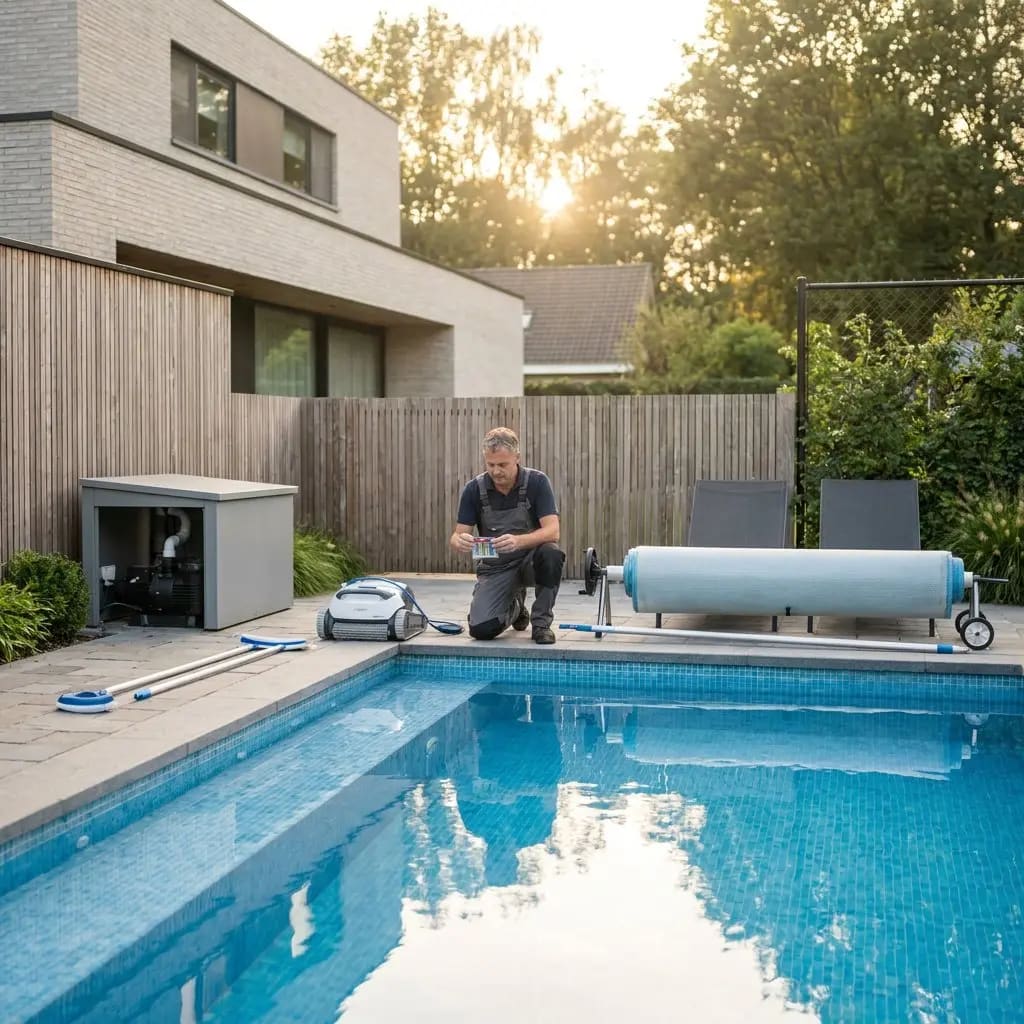
A pool in the garden requires an extra budget every year, even after installation is complete. For an average private pool of around 8 x 4 metres, 1.5 metres deep and with normal use, the annual maintenance cost in Belgium is often between €1,500 and €2,500. With a compact, efficient setup, this can be lower. With a larger pool, a long swimming season or intensive heating, the budget rises more quickly. The biggest differences usually come down to heating, filtration, cover, water treatment and local energy and water rates.
How much do you pay on average per year and per month?
The guide prices below help you estimate your annual budget more accurately. These are recurring usage and maintenance costs, not the purchase or installation cost of the pool. See this as a current indication for 2026 in Belgium, not a price guarantee.
Compact pool, limited heating
Indicative annual cost: €1,000 to €1,500
Indicative monthly cost: €85 to €125
Average outdoor pool with heat pump and cover
Indicative annual cost: €1,500 to €2,500
Indicative monthly cost: €125 to €210
Large pool or long heated swimming season
Indicative annual cost: From €2,500
Indicative monthly cost: From €210
Looking mainly for a quick rule of thumb? Then the question is not just what maintenance costs, but above all how much you heat the pool. Without heating, annual costs often stay noticeably lower. As soon as you want to swim comfortably from spring to autumn, energy usually becomes the biggest cost item.
Which factors determine the annual cost?
The cost of pool maintenance depends less on one fixed amount and more on a few practical choices that are made before you even buy. These are the main cost drivers:
- The size and volume of the pool. More water means more heating, more filtration and usually more maintenance products.
- The desired water temperature and the length of the swimming season. A few degrees warmer or a few extra months of heating quickly makes a difference.
- The quality of the cover and insulation. Heat loss happens mainly through the water surface, so a good cover greatly reduces energy demand.
- The type of pump and filtration control. An efficient, correctly set installation uses less electricity than a pump that is oversized or runs too long.
- The water treatment system chosen. Chlorine, bromine and salt each have a different profile in terms of usage, ease of use and possible replacement costs.
- How the pool is used. Heavy use, playing, splashing and dirt lead to more water loss and extra corrections to the water balance.
- The location and surroundings. A lot of wind, trees, pollen, dust or shade affect both cleaning and the use of products and energy.
That is why guide prices also differ from one home to another, even within the same region. In and around Aarschot, for example, the same factors apply as elsewhere in Belgium, but your own water and electricity contracts remain decisive.
What do the recurring costs consist of?
If you want to calculate pool maintenance cost, it is best to look at four fixed categories: electricity, heating, water and maintenance products. There are also a few smaller costs that are often forgotten.
Electricity for the pump, filtration and basic use
During the swimming season, the filter pump runs several hours a day to keep the water clear and safe. The warmer the water, the more important good filtration becomes. For an average private pool, the basic consumption for the pump, controls and possibly lighting often comes to a few hundred euros per year. With a variable-speed pump and smart timer control, you can save energy with your pool, especially if the pump does not have to run constantly at full power.
Heating the pool
In the annual cost of a pool, pool heating is often the biggest variable. In our climate, most owners do not want a cold pool that is only comfortable during a heatwave. That is why a heat pump is often used, possibly in combination with a cover. For an average outdoor pool with a good cover and a normal swimming season, a guide figure of around €500 to €1,500 per year for heating is realistic. Without a good cover, with higher target temperatures or with a longer season, that can quickly be higher.
Most heat loss happens at the water surface. A proper roller cover or slatted cover therefore helps far more than simply heating a few degrees less. The location also matters: a sheltered, sunny garden requires less energy than an open, windy spot. If you choose an energy-efficient pool at the design stage, you avoid heating remaining the most expensive item for years.
Topping up water and backwashing
You do not normally need to fully drain a pool every year, but topping it up is unavoidable. Water evaporates, splashes out of the pool and is lost when cleaning the pool filters. Backwashing in particular can use more over a year than many people think. In a traditional pool, this often adds up to several dozen cubic metres of extra water per year, depending on the filter type, maintenance routine and use. For many households, this cost remains smaller than energy or products, but it still belongs in a realistic annual estimate.
Maintenance products and water treatment
For clear and healthy pool water, you need products to correct pH, disinfection and sometimes extra products against algae or cloudy water. For an average pool, that ongoing cost often comes to around €250 to €600 per year. The exact amount depends on water quality, the weather, pool usage and the treatment system chosen.
The method chosen also makes a difference. Chlorine remains the best-known solution for many pools. Bromine is used less often and is usually more expensive in day-to-day use. A salt system can reduce annual product costs, but it requires a higher investment and, over time, replacement of parts. For people who are still looking to buy, that is an important distinction: not only the purchase price matters, but also how the system performs year after year.
Extra costs that are often forgotten
Besides the fixed cost items, there may also be additional expenses. Think of a professional start-up in spring, winterising, replacement of filter media or a repair to the robot, pump or dosing system. In some situations, tailored insurance can also mean a small extra cost. These are not fixed monthly amounts, but they do belong in a complete picture of the annual cost of a pool.
How to keep pool maintenance costs lower
Low-cost maintenance does not start with less care, but with smarter use. With these pool maintenance tips, you can keep the budget under better control without sacrificing water quality or comfort.
Always cover the pool when it is not in use
A cover such as a roller cover for your pool limits heat loss, evaporation and dirt all at once. That means you save not only on heating, but also on top-up water, filtration and chemicals. For many pools, this measure has the biggest impact on annual costs.
Limit dirt and unnecessary water loss
Leaves, grass, sun cream, dust and pets put more strain on the water than many owners expect. The less dirt that gets into the pool, the less you need to vacuum, backwash and correct. A robot also helps clean efficiently without unnecessary water loss, as can happen with some manual cleaning routines.
Set filtration and pump operation correctly
A pump that runs too long or at unnecessarily high power uses too much electricity year after year. Have the filtration matched to the volume, season and water temperature. Variable speed or smart control often makes a big difference here.
Test water chemistry in good time
Waiting until the water turns green or cloudy is almost always more expensive than testing regularly. By keeping pH and disinfection stable, you avoid major corrections, shock treatments and extra product use. Small adjustments are cheaper than solving problems afterwards.
Winterise the pool correctly
Good winter maintenance prevents you having to start spring with dirty water, long filtration times and heavy chemical corrections. If you clean at the right time, balance the water and protect the installation properly, you usually save money on reopening.
Frequently asked questions
How much does pool maintenance cost per month?
For an average private pool, the monthly cost is often around €125 to €210. With a compact pool and limited heating, this can be lower. With a large pool or a long heated season, the monthly budget is higher.
How much does a pool cost per year in electricity?
For the pump and basic consumption alone, many owners allow a few hundred euros per year. As soon as you also heat the pool, electricity or energy becomes a much larger cost item. Total energy cost depends mainly on the swimming season, water temperature, cover and type of installation.
Are salt, chlorine or bromine cheaper to maintain?
Chlorine is often the simplest starting point in terms of ongoing budget. Bromine is usually higher in consumption. Salt can reduce recurring product costs, but it does require a higher installation cost and later replacement of parts. So always look at the total cost of ownership, not just the price of the product.
Do you need to fully drain a pool every year?
No. In most cases, topping up, filter maintenance and a proper seasonal approach are enough. Fully draining is usually not necessary and can even be impractical or undesirable, depending on the type of pool and the technical situation.
Does a pool increase the value of my home?
It can, but it is not a fixed rule. The added value depends on the type of property, the garden finish, how easy the pool is to maintain and demand in your region. For buyers, it is not only about luxury, but also about the expected annual cost.
Anyone considering a pool should therefore not compare only the purchase price of a pool. The real difference often only becomes visible in annual use. If you want a more realistic picture of the costs for your garden project, have the volume, heating, cover and water treatment assessed together before you decide.

Ready to start building your dream swimming pool?


