
Swimming Pool Leak Detection
 Written byFilip De Weer — CE0November 11, 2026
Reviewed by: Leisure Pools Technical Team
Last reviewed: November 11, 2026
Not sure whether your pool has a leak? Learn how to tell evaporation from leakage, check it yourself and when swimming pool leak detection is worth it.
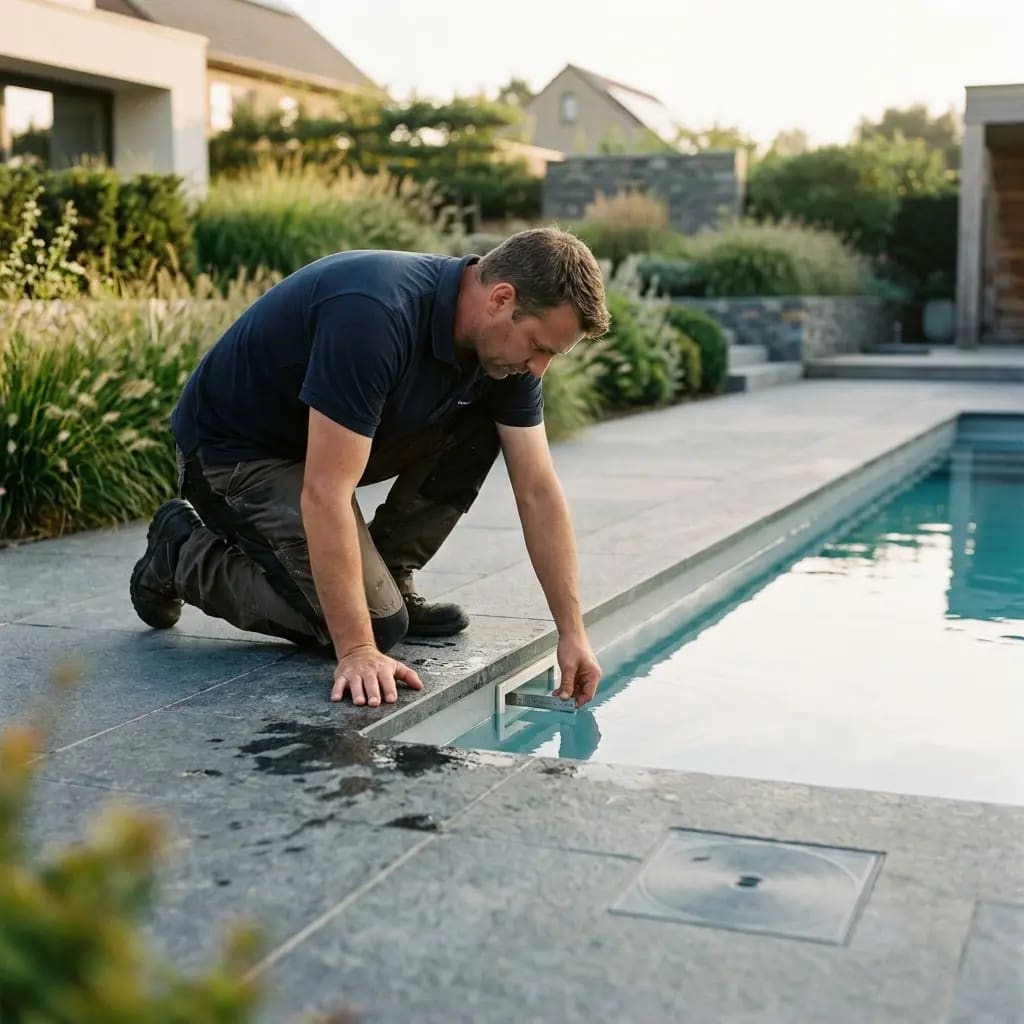
A falling water level does not automatically mean that your swimming pool is leaking. Warm weather, wind, a higher water temperature and heavy use naturally cause evaporation, especially without a pool cover. Only when you have to top it up noticeably often or the level drops clearly faster than normal is further investigation advisable.
The most practical approach is step by step: first interpret the signs correctly, then carry out targeted checks yourself, and only then consider professional leak detection. Many leaks are not a visible hole in the middle of the shell, but at penetrations, pipework or components in the pool plant room. That is exactly why they can often be located in a targeted way without breaking anything open straight away.
First determine: is your swimming pool really losing too much water?
A limited drop in the water level can be normal, especially in sunny or windy periods. It becomes suspicious when you regularly have to top it up or when the loss suddenly increases. If you do not see a crack or hole, that does not rule out a leak: problems are often in concealed connections, pipework or technical components. If in doubt, do not wait too long, because assessing it early prevents unnecessary water loss and greater consequential damage.
Signs that are rarely explained by evaporation alone
- The water level drops faster than you are used to and you have to top it up noticeably more often.
- You notice air bubbles at the return jets, pressure loss or a pump that operates less steadily than normal; checking your pool pump maintenance can then help.
- Damp patches, wet grass, local subsidence or discolouration at a joint or lining appear around the pool.
- Greater water loss sometimes goes hand in hand with extra heat demand or faster use of water-treatment products.
- One sign alone does not prove anything, but several indications at the same time do make a leak plausible.
Where leaks usually occur: floor, wall, penetrations or pipework
Zone
Why check more carefully here?
Wall, floor and joints
Small damage, a discoloured joint or a mineral trace can indicate a leak. Leaks in the floor are often harder to see than leaks in the side wall.
Finish or liner
Welded seams, transitions and local wear are logical inspection points when the pool has a finish layer.
Skimmer, return jets and lighting
Through-wall fittings and seals are classic risk points because different parts connect to each other here.
Filter system and pipe connections
Pumps, couplings and technical equipment can cause water loss or air ingress. If the shell shows little out of the ordinary, concealed pipework deserves extra attention.
Checking it yourself: 5 targeted tests without breaking anything open
If you are wondering how to detect a water leak yourself, it is best to carry out these five checks in a fixed order:
- First mark the waterline with a piece of tape or a pencil mark on a fixed reference point. This allows you to see objectively how much the level drops in 24 hours.
- Then do the bucket test: place a bucket of water on a step or stable platform and compare the water loss in the bucket and the pool after a day. If the pool drops clearly faster, evaporation is not the only explanation.
- Compare the loss with the system switched off and with the system running. If the difference is greater while the pump is running, that more often points to a problem in the pipework, couplings or other technical components.
- Then systematically check all sensitive zones: joints, skimmer, return jets, lighting, filter connections and the ground around the pool. Look for moisture, discolouration, small deposits or soft spots.
- With temporary pools, such as an Intex or other inflatable pool, you can sometimes make small perforations visible on dry sections with water or diluted washing-up liquid. Also check the underside and test again after each patched spot, because several mini-leaks can occur at the same time.
When professional leak detection is the logical next step
If the water loss continues while your own checks do not reveal a clear cause, professional leak detection is usually the wisest next step. This certainly applies if you suspect concealed pipe leaks, hard-to-reach damage in the floor or technical symptoms such as pressure loss and air in the system. Acting quickly not only limits additional water loss, but also the risk of damage to the terrace, garden, structure or installation. A specialist provides targeted clarity before anything is opened up or repaired at random.
Which techniques specialists use to pinpoint a leak exactly
Professional leak detection is usually non-destructive. The goal is not only to confirm that there is a leak, but above all to determine exactly where it is.
Technique
What is it used to investigate?
Mainly useful for
Pressure test
Checking individual pipes or circuits for pressure loss
Suspected supply or return pipework
Acoustic measurement
Listening for escaping water or air
Hidden leaks in pipes or penetrations
Tracer gas
Detecting gas that escapes through the leak
Hard-to-reach or non-visible leak zones
Thermography
Making temperature differences in the surface or structure visible
Zones where moisture spreads out of sight
Camera inspection
Visual inspection of technical components or pipes
Specific suspicious sections or components
Which method is most suitable depends on the suspected leak zone: the shell, a penetration, the pipework or the technical installation. In practice, techniques are often combined, because several measurements increase accuracy and help to avoid breaking anything open unnecessarily.
What determines the cost of leak detection?
The cost usually depends on the time needed for the investigation, the accessibility of the swimming pool, the number of suspected circuits or components, and whether extra measurement steps are required. Leak detection and repair are also two separate items. Always ask exactly what is included in the investigation, the report and any follow-up. If extra time, additional tests or a second visit prove necessary, it is wise to have confirmed in advance how that extra work will be charged.
How we at Leisure Pools Benelux look at leak risk
At Leisure Pools Benelux, we always assess possible water loss from both the structure of the swimming pool and the hydraulics behind it. Our practical knowledge comes from construction, technical documentation and pool maintenance. Because our own technicians carry out the installation and we also provide annual summer and winter maintenance, we know which zones require extra attention: penetrations, pipe routes, technical components and stable installation. A well-documented installation and maintenance history often makes an initial analysis faster and more targeted, including when an external leak detection specialist later needs to carry out measurements.
Frequently asked questions about leaks in your swimming pool
Is leak detection covered by warranty or insurance?
That depends on the cause and on the conditions that apply. Manufacturer's warranty, seller's warranty and insurance do not assess the same things: a product or installation issue, sudden damage, wear and overdue maintenance are often treated differently. Temporary pools usually have separate product conditions. Always ask whether only the detection, only the repair or both are covered, and keep photos, invoices and the diagnosis safely stored.
What if the leak is not found straight away?
That does not automatically mean there is no leak. Sometimes there are several small leaks, the cause is in a hard-to-reach circuit, or one part of the installation first has to be tested separately. Logical next steps are additional targeted measurements, further isolation of circuits or extra inspection of suspicious components. Only let follow-up work start after the approach and costs have been clearly agreed.
How do you temporarily repair an Intex or inflatable pool?
Start by pinpointing the perforation or leaking seam exactly on a clean, dry area. A suitable repair patch can temporarily seal a small hole, but then check the entire pool again, including the floor and seams. Especially after storage or moving, several mini-leaks can be present at the same time. Temporary sealing is also different from structural repair.
How many years does an Intex pool usually last?
There is no fixed number of years for that. The lifespan depends heavily on the material, sun exposure, the sub-base, water treatment and the way it is stored. If new small leaks appear after every winter, or if especially the floor and seams keep weakening, that more often points to material fatigue than to one accidental damage. In that case, continuing to patch is not always the most durable choice.

Ready to start building your dream swimming pool?


