
Choosing a Swimming Pool Location
 Written byFilip De Weer — CE0November 16, 2026
Reviewed by: Leisure Pools Technical Team
Last reviewed: November 16, 2026
Discover how to choose the best location for a swimming pool based on use, plot layout, access, technical setup, drainage and local permit rules.
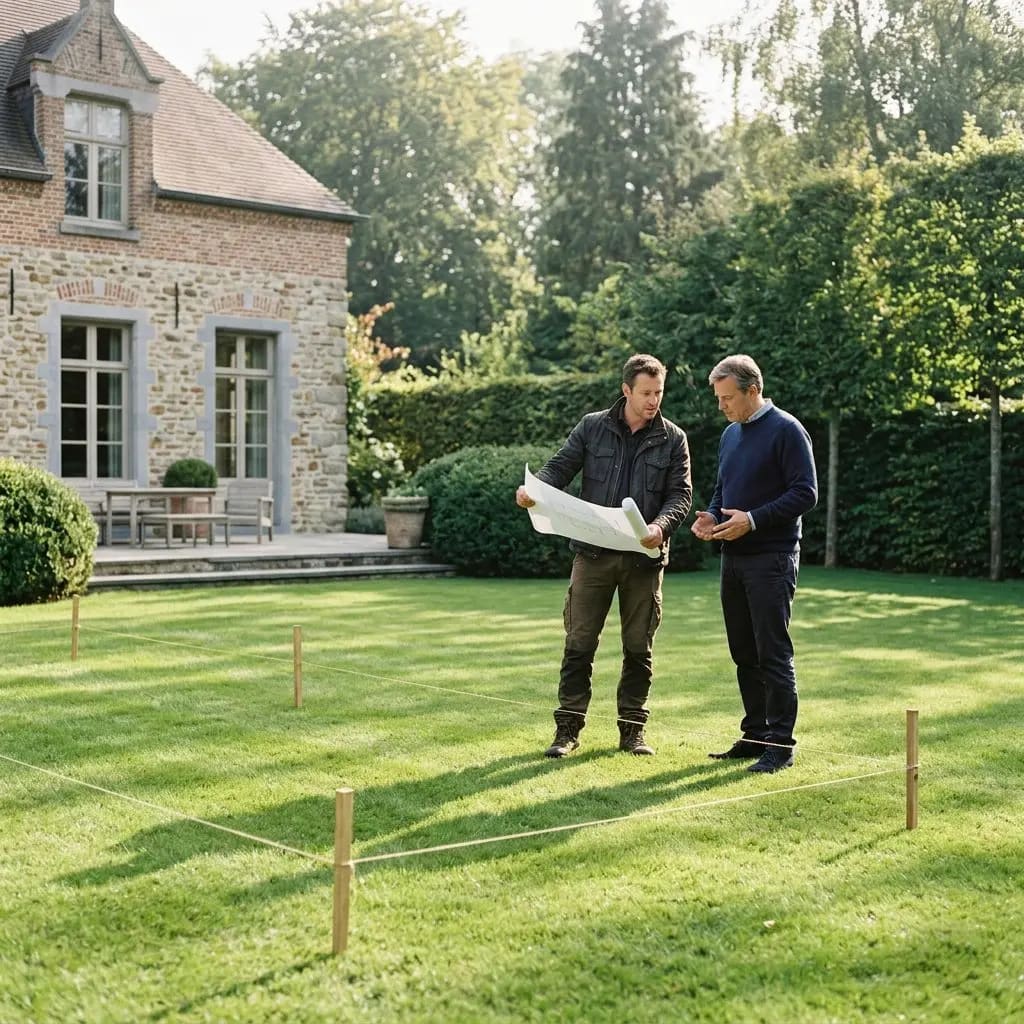
The best location for a swimming pool is rarely just the largest open spot in the garden. Good siting brings together day-to-day comfort, technical feasibility and local rules in one logical choice. It is not only about views and space, but also about access to the plot, changes in level, the composition of the subsoil and room for the technical installation. If you clarify those points first, you avoid surprises in the budget, the execution and the permit process. Especially with a prefab in-ground swimming pool, it pays to assess the location before the model, finish and planning are finalised.
Start with use, comfort and safety
A swimming pool intended mainly for relaxation is ideally not always in the same place as a pool used for daily lap swimming or where children will spend a lot of time. The location should therefore first match the pattern of use. Do you want to get into the water quickly from the terrace or the house, are you mainly looking for peace in a more sheltered area, or is keeping an eye on children at play the deciding factor?
Think beyond the current situation as well. What seems practical now may prove less logical over time when children grow older, supervision remains important or the garden is laid out differently. A spot close to the living area can encourage more frequent use of a swimming pool in the garden, while a more secluded position may suit privacy and peace better. Neither is automatically the right choice: it depends on how you want to experience the pool day to day.
That is why it is wise to define the intended use first and only then fix the technical or aesthetic choices. This prevents the location from being chosen on ease of excavation alone, only to prove less comfortable or less safe in practice.
Assess your garden technically: space, changes in level and subsoil
Once the intended use is clear, the next step is a technical assessment of the garden. Do not look only at the area on the plan, but at the space that is genuinely usable. The dimensions of the swimming pool, the desired in-ground installation and sufficient circulation space around it all need to fit together, without the garden becoming functionally cramped. Even with a garden design with a swimming pool, terraces, existing planting, walls or other fixed elements can significantly reduce the effective installation zone.
Changes in level make a major difference here. With a swimming pool in a garden with changes in level, an apparently attractive location may require extra groundworks, raising ground levels or technical corrections, while a less obvious area may be far simpler and more stable to build. The same applies to the subsoil: the chosen spot must be suitable for accurate excavation, a stable foundation and correct alignment.
That is precisely why it is wise not to choose the pool model too early. First, it needs to be clear what the plot technically allows and which area offers the best combination of space, stability and practical feasibility. Only then can you choose a location with greater certainty, one that not only looks good but is also technically sound.
Access to the plot also helps determine cost and feasibility
Many pool projects are first considered in terms of shape, size and appearance, while access to the plot is discussed only later. That is a pity, because access often determines both the price and the practical feasibility. Machines for excavation, removal of soil, delivery of materials and any crane work need a workable route from the street to the garden.
If that access is narrow, winding or restricted by existing buildings, the complexity usually rises quickly. Additional protection measures, special lifting work, longer working times or a different site organisation can affect the cost. Especially with a prefab in-ground swimming pool, this is an important point, because delivery and installation of the pool shell require sufficient manoeuvring space and a well-considered delivery route.
So have that access assessed before the design and budget are fixed. A location that is technically feasible on paper is not automatically easy to carry out in practice. Where accessibility is limited, it should also be checked explicitly whether a prefab shell can still be installed as a single piece in practice, without unexpected interventions afterwards.
Do not forget the plant room, hydraulics and maintenance access
A good swimming pool location also takes into account everything you do not see once the pool is finished: filtration, heating, dosing systems, pipework and service access. So allow for an easily accessible zone for the technical systems, so that maintenance and interventions do not become needlessly cumbersome.
The more you opt for automation and ease of use, the more important a well-thought-out technical layout becomes. In addition, the choice between skimmer and overflow affects the construction and positioning. With a skimmer pool, the practical wind direction also matters, because it also influences where floating debris ends up. Anyone who considers the technical side too late risks adjustments after excavation or installation.
Check permit requirements, plot boundaries and water drainage before you decide
Before you definitively choose a location, it is wise to check whether a permit application for a swimming pool is required. This is not only about depth. Distance from plot boundaries, total surface area, any hard surfacing, technical elements and the way water is drained can all play a role in the assessment by the competent authority.
So check at an early stage which rules apply to your plot and your planned configuration. There is no universal answer to the question of which pool layout is always exempt from a permit, because the location and the way it is built also help determine what is or is not possible. Those who only look at permit requirements, plot boundaries and drainage late in the process are more likely to face redesigns, delays or discussions later on.
When a technical site visit is the smartest step
Sometimes the best location is clear quickly. In other gardens, a technical site visit is the step that turns doubt into a realistic plan, especially in these situations:
- Access to the garden or plot is limited and you are not sure whether delivery, crane work and groundworks are practically feasible.
- There are changes in level or complex zones in the garden, so it is not immediately clear which spot is technically the most logical.
- You are unsure where the plant room should be and whether filtration, heating, pipework and maintenance access will have enough space.
- Drainage is not straightforward, for example with a swimming pool where groundwater is high, and you want to know in advance how rainwater or backwash water can be correctly incorporated into the plan.
- You are comparing several proposals and do not want simply to compare prices, but also to check whether the plot conditions have genuinely been assessed technically.
- You only want to fix the model, planning and budget once the location, connections, accessibility and execution have been assessed as a whole.

Ready to start building your dream swimming pool?


