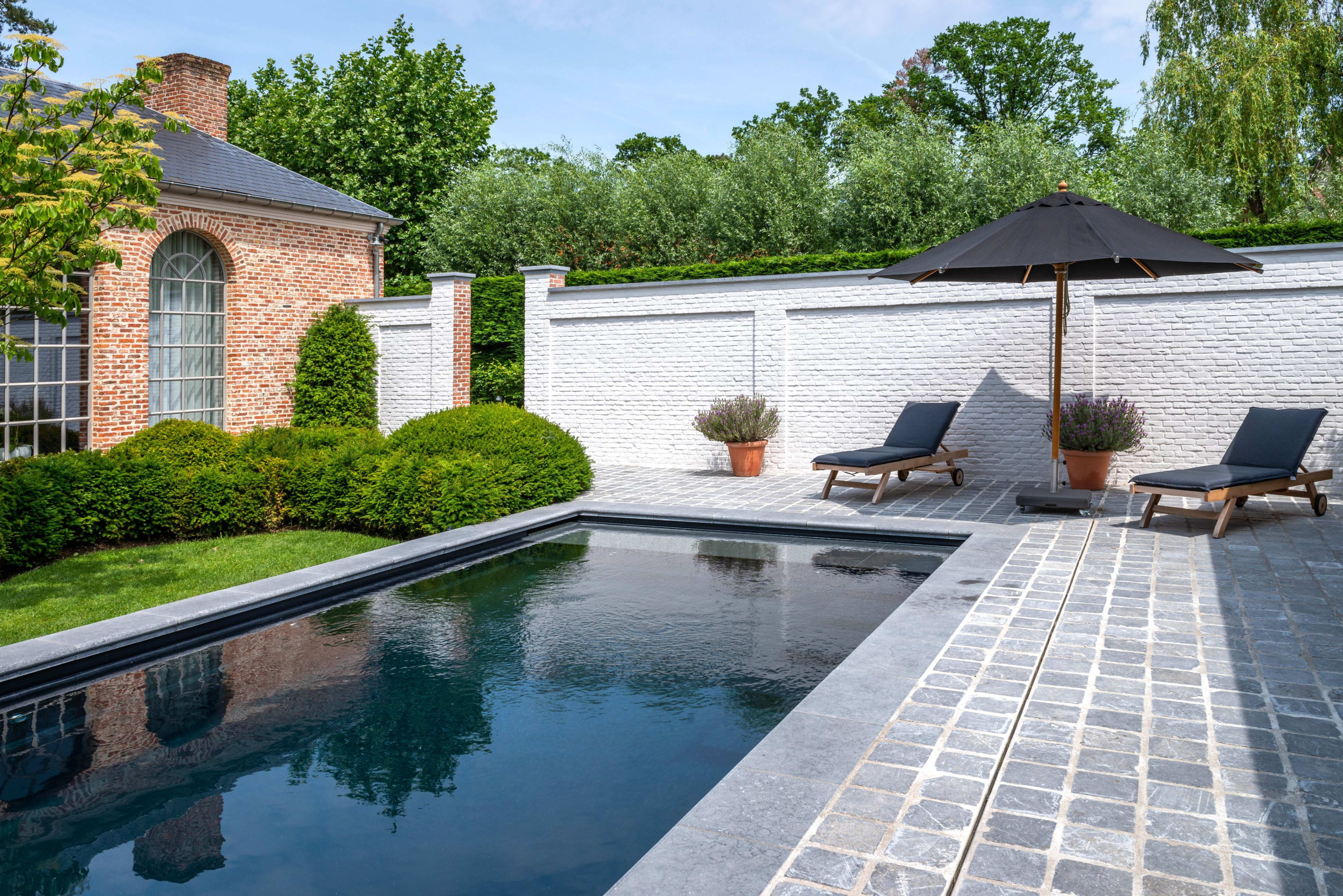
Swimming pool in a sloping garden
 Written byFilip De Weer — CE0October 23, 2026
Reviewed by: Leisure Pools Technical Team
Last reviewed: October 23, 2026
Learn how a swimming pool fits in a sloping garden: layout options, technical considerations, costs, dimensions and local installation rules.

What a sloping garden changes in installation and construction
A sloping garden changes not only where the pool goes, but also how you excavate, build up and use the space around it. On a flat plot you usually work from one level; with a change in level, you first have to determine which level will be the reference for the terrace, access and the view from the house. That affects the amount of earthworks for a swimming pool, the build-up height and the finishing around the pool. At the same time, a sloping garden offers opportunities: you can work with a deck, a terrace level, a strong sightline or a partly raised installation. Do not confuse this with a pool with a sloping bottom: that is about the depth inside the pool, not the gradient of your garden. The first assessment therefore focuses on the slope, the soil, existing terraces and whether full excavation is desirable or feasible.
Which pool setup works best with a change in level?
The best setup mainly depends on the available space, the desired depth and how much site work you want or are able to do.
Setup
When it makes sense
Practical effect
Fully in-ground on a levelled surface
If you have enough space to create one flat terrace level
A lot of excavation work, but a clean and calm connection to the garden
Semi-inground with retaining wall or deck
With a clear change in level or when you do not want to excavate fully
A good balance between engineering and appearance; compact or wellness-oriented sizes often fit more easily here
Raised installation
When excavation options are limited or the site is difficult to access
Less deep excavation, but more attention to steps, safety and visual integration
Technical points to consider before the first excavation works
Before any digging starts, the technical picture has to be right. In a garden with a change in level, these points are especially decisive:
- A level, load-bearing foundation is essential. The pool must be fully and stably supported, including when parts of the structure are closer to a slope or raised ground.
- Retaining structures need to be thought through in advance. If the pool or terrace partly rises above ground level, it must be clear how the surrounding soil will be retained and what loads act on it.
- Drainage and water runoff are even more important on a sloping plot. Rainwater must not be directed towards the pool, the terrace or the technical room.
- Site access often determines how the work is carried out. Think about crane work, deliveries, excavators and enough working space on different levels.
- The area around the pool must also be safe. Terraces and coping stones, steps, walkways, a deck and any fall protection must accommodate the change in level safely and comfortably.
Location, dimensions and distance to the plot boundary
The right place to install a swimming pool is determined not only by the free space, but also by sun, wind, privacy, sightlines and the route between the house and the pool. In a garden with several levels, that is even more important: a beautiful pool in an awkward position will feel less successful in practice. A compact pool requires less level space and fewer transition structures than a family pool or a longer swimming setup. So measure not only the shell, but also the edge zone, steps, technical access and the connection between the different garden levels. Finally, take local rules on the distance to the plot boundary into account, because retaining walls, terraces or other associated structures may also be assessed.
What does a swimming pool in a sloping garden cost?
With a change in level, the budget difference rarely lies only in the pool itself. It is mainly the site works and finishing that have the biggest impact.
Cost driver
Why this has an impact
Pool and size
A larger pool usually requires more level space, more edge finishing and more circulation area
Earthworks and foundation
Excavation, soil removal, raising levels and levelling often account for a large part of the difference
Retaining walls and drainage
Needed to keep levels stable and dry
Site access
Difficult access may require extra transport, crane work or more labour
Finishing
Terrace, steps and deck make the change in level usable and aesthetically finished
Less excavation can sometimes save money, but a partly raised installation or extra structural work can offset that gain again.
Permit, preparation and the installation process
With a sloping garden, an early technical plan pays off even more. Not only the pool counts, but potentially also changes to the terrain and associated structures.
- Start with an accurate survey of the plot, including levels, existing paving, slopes and the available access to the site.
- Then choose which level will be the reference: the level of the house, the existing terrace or a newly constructed platform around the pool.
- Next, work out the technical side: foundation, any retaining walls, drainage, water runoff and the connection of steps, path or deck.
- Only then should you check the local regulations. Depending on the situation, raised ground levels, paving and retaining structures may also be relevant from a permit point of view.
- Then plan the works and logistics, so that deliveries, crane work and machinery can be handled safely and efficiently.
- The installation process itself usually follows this line: earthworks, foundation or base slab, placement of the pool, backfilling and stabilising, and then finishing the surrounding levels.
When a polyester pool makes sense with a change in level
A polyester pool can be an interesting option if you want a sleek, fixed shape and smooth installation, provided the base structure and the site are properly prepared in advance. With a change in level, the solution usually does not lie in a custom-made pool bottom with all kinds of slopes, but in the garden layout around it: terrace levels, a deck or a semi-inground installation. Design freedom therefore often lies more in the edge finishing and the connection between levels than in the shell itself. Anyone considering a Leisure Pools Benelux polyester pool should therefore include the technical preparation and the chosen setup from an early stage when requesting a free quote for a swimming pool.
Ready to start building your dream swimming pool?