
How to Insulate a Swimming Pool: What Really Works?
 Written byFilip De Weer — CE0November 9, 2026
Reviewed by: Leisure Pools Technical Team
Last reviewed: November 9, 2026
Find out where a swimming pool loses heat and which swimming pool insulation works best: an insulated pool cover, floor, wall and pipe insulation.
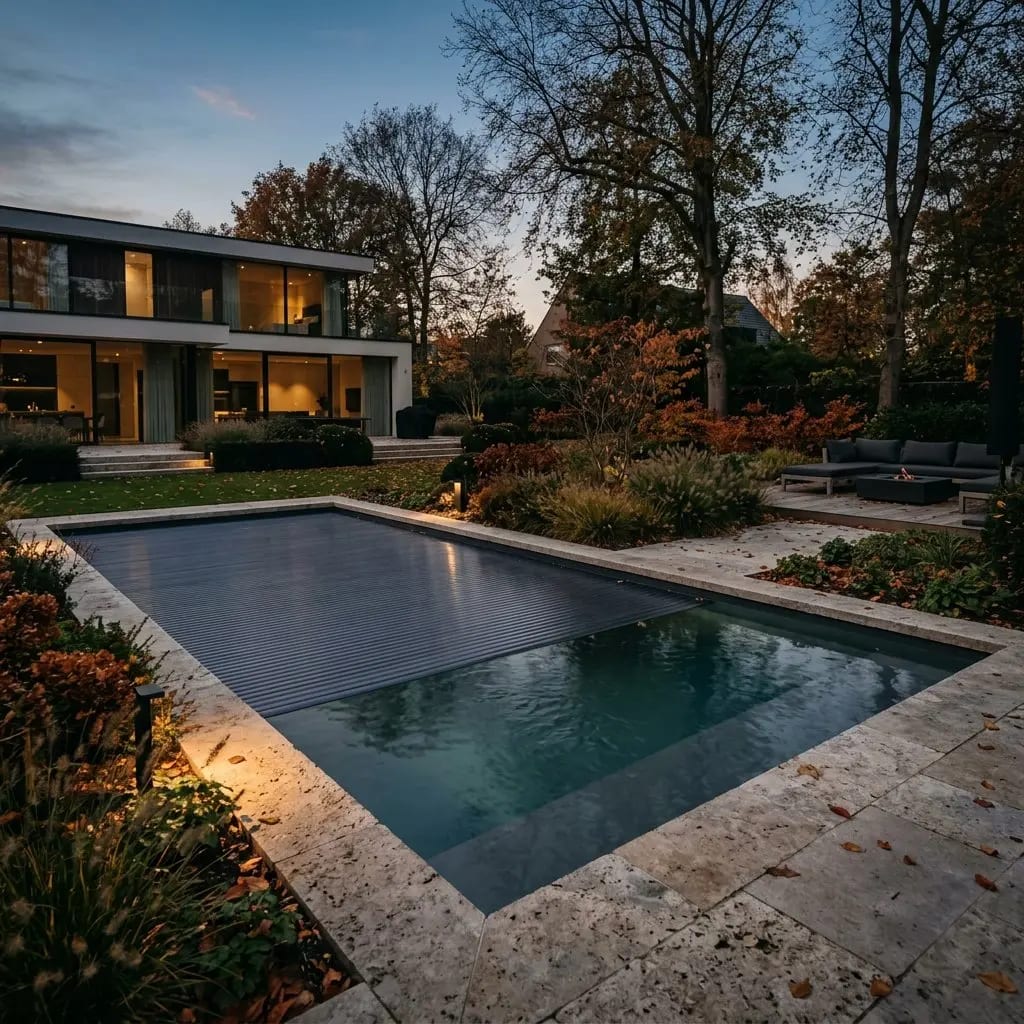
Anyone who wants to insulate a swimming pool usually achieves the biggest gains not with extra boards in the wall, but by limiting heat loss at the water surface. Evaporation and contact with cooler outside air are typically the biggest energy leaks, which is why a good cover for an energy-efficient pool often delivers more than extra wall insulation alone.
That does not mean base, wall and pipe insulation are of little use. Especially in a new build or a thorough renovation of an outdoor pool, they can help keep the water temperature more stable and reduce heating demand. Below, we compare the solutions that make the biggest difference in practice, from covers to insulation boards and the right approach for each pool type.
Where a swimming pool loses the most heat
In a swimming pool, most heat is usually lost through the water surface. As soon as warm water comes into contact with cooler outside air, heat transfer occurs. Evaporation amplifies that effect even further, especially on cold nights, windy days and in spring and autumn. As a result, an open outdoor pool can cool down surprisingly quickly, even when the shell itself is solidly built.
Wall and base insulation are certainly useful, but in day-to-day use their impact is often less immediately noticeable than covering the water. They limit heat loss to the ground and the surrounding structure. There are also transport losses in pipework and equipment, especially with longer runs through cold zones or underground. So insulating a swimming pool is certainly worthwhile, but not every part delivers the same effect when you want to save energy in a targeted way.
Why a cover on the water surface usually delivers the biggest gains
Anyone who wants quick, visible results usually starts with a slatted pool cover or another cover on the water.
- An insulated slatted cover tackles the biggest source of heat loss directly. It helps keep the water temperature more stable, limits evaporation and reduces the load on the pool heating.
- A simpler cover sheet or bubble blanket is often a logical first step. The insulation value is lower, but these solutions too can help noticeably if the pool would otherwise be left open regularly.
- A liquid cover can be interesting when covering the pool every day is impractical. It mainly focuses on limiting evaporation, but it requires realistic expectations.
- Not every solution does everything at once: some covers also keep out dirt, while others mainly retain heat. A cover does not automatically add safety either.
When base, wall and pipe insulation make sense
Base and wall insulation are especially interesting when an in-ground pool still has to be built or when the pool is already being opened up during renovation. You can then include the insulation in the build-up without having to break everything out again later. Their function is clear: limit heat loss to the ground and the surrounding structure, so the pool stays at a more even temperature.
Pipe insulation pays off especially on long pipe runs, underground connections and technical rooms that can become cold. Otherwise heat is lost along those sections on the way between the pool and the equipment. Insulating a swimming pool externally can also make sense, but only if compressive load, moisture exposure and drainage are technically correct. Without the right build-up, external insulation around a swimming pool can later create more risk than benefit.
Which insulation boards are technically suitable under and around a swimming pool
Under and around a swimming pool, it is not just the insulation value on paper that counts. A board must also be able to take load, keep its shape and absorb as little moisture as possible. That is why the right choice differs by application: under the pool base, against a wall, under supporting layers or in connection details around the pool.
Material
Compressive strength and moisture
Insulation value
Where it usually fits
Point to note
XPS
Usually high compressive strength and low water absorption, which means it performs well in damp and heavily loaded situations.
Good and stable in practice, especially where load and moisture are factors.
Often the most logical choice under a pool floor, under supporting layers and against moisture-exposed external walls.
The correct thickness and compressive strength class must be matched to the build-up and the load of the project.
EPS
Can be usable in protected build-ups, but is more sensitive to moisture and deformation than XPS.
Solid, often interesting when budget plays a bigger role.
More suitable in lighter, drier edge details or in build-ups where the board remains well protected.
Less obvious where permanent load, ground moisture or direct moisture exposure are important.
PIR
Not chosen for moisture resistance alone, but above all for high insulation with limited thickness.
Very strong per centimetre of build-up thickness.
Especially interesting in dry, protected connection details around the pool or where little build-up height is available.
Under a swimming pool or against permanently moisture-exposed parts, it is usually not the first choice without a very well thought-out detail build-up.
So for a pool base or pool floor, it is not only the lambda value that matters, but above all how the board behaves under permanent load and moisture. Against a wall, the water load from outside also matters. That is why XPS is often the most obvious choice in damp, heavily loaded applications, while EPS remains more budget-oriented and PIR mainly makes sense when every centimetre counts.
How insulation differs by pool type: in-ground pool, above-ground pool, Intex and spa
The best approach depends strongly on the type of pool and on what is still technically feasible.
- With an in-ground pool, the best results come when the cover, base build-up, wall details and pipe runs are already included in the design.
- With an above-ground pool or Intex pool, the emphasis is usually more on a level, stable and lightly insulating base and on a practical cover than on heavy structural wall insulation.
- Under a liner, an even, protected build-up is important. The insulation layer must not cause imprints, damage, sharp transitions or unevenness.
- For round pools, HDPE structures and spas, the same basic principles apply, but compatibility with the specific build-up and the manufacturer's instructions always remains decisive.
Installing swimming pool insulation without common mistakes
A good choice does not start with the highest insulation value, but with the right solution for the situation.
- Choose insulation based on load, moisture, location and application. A board that works well in a dry detail is not automatically suitable under a pool base.
- Ensure a level, stable and dry substrate. That prevents boards from shifting, deforming or causing moisture problems over time.
- Carry pipe insulation through continuously wherever heat loss occurs, especially on long or cold runs. Interruptions at bends, joints or penetrations reduce the effect.
- Do not insulate equipment blindly. Completely wrapping a pump or technical zone is not a good idea if accessibility and ventilation are lost.
- With existing pools, the biggest practical gains often still lie in covering the pool, insulating accessible pipes and improving other accessible details.
How we incorporate insulation into the design and installation of a swimming pool
At Leisure Pools Benelux, we do not see insulation as a separate add-on afterwards, but as part of the complete pool build-up. Because we install prefab in-ground pools with our own technicians and also carry out annual summer and winter maintenance, we see clearly in practice which choices can still be adjusted later and which already need to be fixed at an early stage.
That usually starts with the type of cover, but the floor and wall build-up, the routing of the pipes and the location of the equipment also help determine how stable the temperature remains. Our technical approach aligns with durable shell materials, energy-efficient pool technology and user comfort. In a prefab in-ground pool with an epoxy-vinylester shell, that coherence helps us assess realistically for each project which insulation measures truly deliver a return and which upgrades are still feasible later, with a free quote as the logical next step.

Ready to start building your dream swimming pool?


