
Polycarbonate Pool Slats for Your Swimming Pool
 Written byFilip De Weer — CE0November 7, 2026
Reviewed by: Leisure Pools Technical Team
Last reviewed: October 29, 2026
Discover how polycarbonate pool cover slats work, what solar versions add, and when they are technically the better fit than PVC for your swimming pool.
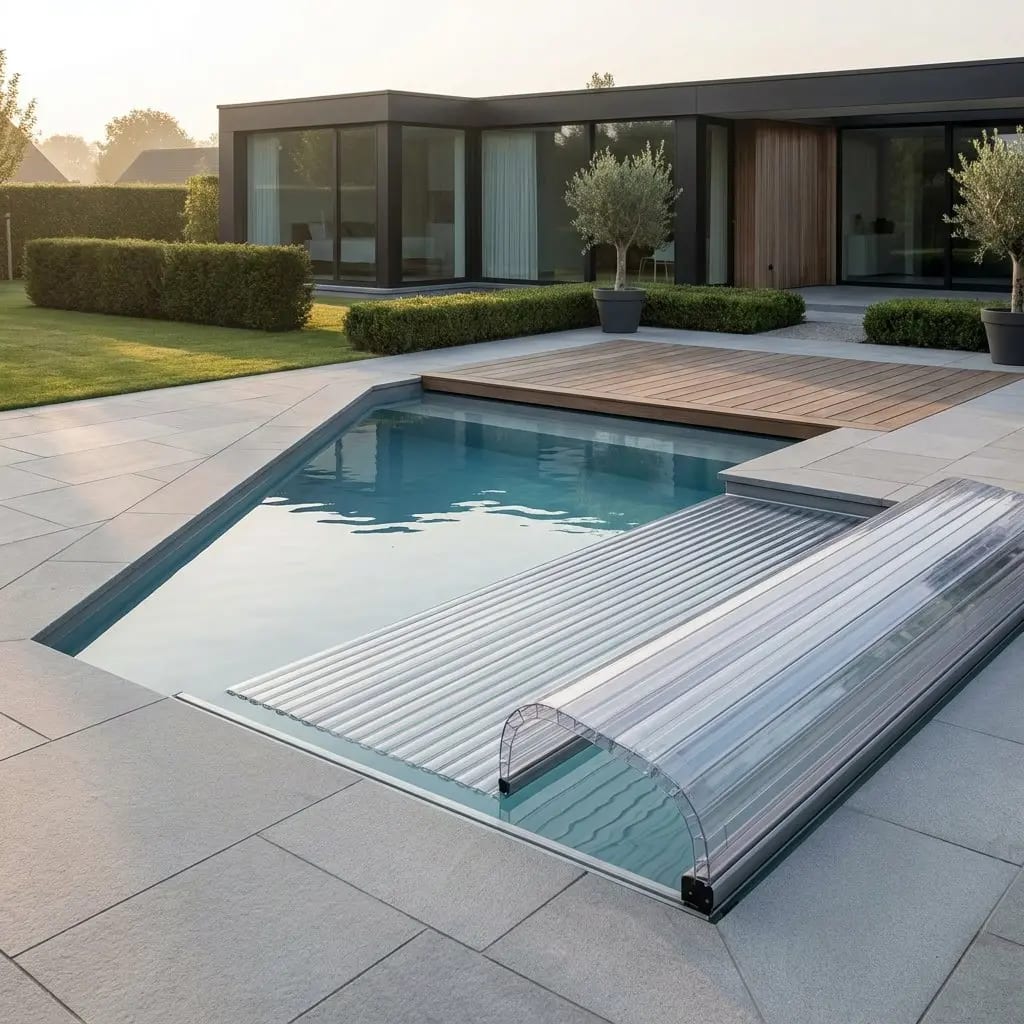
Polycarbonate pool slats neatly close off your swimming pool and do more than simply cover the water. They limit heat loss and evaporation, helping to create an energy-efficient swimming pool, keep dirt out of the pool more effectively, and provide additional protection for the water against sun, rain and other weather conditions. You notice that not only in terms of comfort, but also in day-to-day use and maintenance.
For many pool owners, the choice ultimately comes down to the comparison with PVC. Strength, UV resistance, service life, possible solar heating and total cost of use differ noticeably by material. Below, you will find a practical guide to choosing between standard polycarbonate, solar polycarbonate and PVC variants, so you can quickly see what best suits a new or existing swimming pool.
How slats affect heat, safety and water quality
A slatted cover mainly helps to retain heat in the swimming pool, limit evaporation and keep leaves, dust and other dirt out of the water. This also supports water quality, because the pool becomes dirty less quickly. In addition, a closed cover provides extra protection, but the real level of safety always depends on the full system, the installation and any certification. So the choice of material does not only determine the appearance, but is also linked to the choice of swimming pool finishes and accessories, insulation, durability and possible solar heating.
What makes polycarbonate technically stronger than PVC
Polycarbonate is generally stiffer and more impact-resistant than PVC, allowing slats to remain dimensionally stable better in sun, heat and day-to-day loads. In practice, this often translates into a longer service life, although water chemistry, location and usage always play a role. Polycarbonate also usually scores more favourably against hail, storm impact and UV ageing. Here, not only the base material matters: profile design, wall construction and the quality of the raw material used also determine how well a slat actually performs.
Why solar polycarbonate slats do more than simply cover
Solar polycarbonate slats are designed not only to cover the pool, but also to make use of solar heat. A light-transmitting top side and heat-absorbing underside help transfer solar radiation to the pool water. The exact temperature gain does vary by situation: solar exposure, location, circulation and how often the cover remains closed all play a role. A dark or light-blocking underside may also let less light through beneath the cover and thus help limit algae growth. Standard polycarbonate mainly focuses on protection and durability; solar adds a functional heat contribution to that.
PVC, PVC solar or polycarbonate: the differences at a glance
The best choice for a roller shutter for your swimming pool usually depends on your budget, desired service life and need for passive heating.
Option
Strong points
Points to consider
Mainly suitable for
PVC
Limits evaporation and heat loss, with the lowest entry price.
Often more sensitive to UV, heat and hail, usually with a shorter practical service life.
Projects where the initial budget carries the most weight.
PVC solar
Combines covering with extra use of solar heat.
The solar gain remains situation-dependent and the material remains PVC-based.
Those looking for extra heating without moving straight to a premium material.
Polycarbonate
Stiffer, more impact-resistant and generally better able to withstand UV and weather exposure.
Higher purchase price; performance varies by profile quality and construction.
Those focusing on durability, weather resistance and a premium finish.
Polycarbonate solar
Combines a strong material base with passive solar heating.
Highest price position; heat gain depends on sun, location and use.
Those who want to optimise comfort, service life and additional heat gain together.
Build quality: the details that really determine performance
The material name alone never tells the whole story. Wall thickness, profile shape, end finish and production quality directly affect stiffness, buoyancy and insulation. As a result, a good PVC slat can perform better than a poorly made polycarbonate slat, and vice versa. That is why it also pays to look at sealing, condensation behaviour, maintenance and safety of the full system.
Sealing, profile construction and condensation
Good sealing is essential to preserve the buoyancy and insulating performance of a slat. Connections, end caps and the production method help determine how watertight and durable the profile remains in the long term. Condensation inside a slat can occur, especially in more transparent solar versions, and does not automatically indicate a defect. More important is whether the system remains structurally well sealed and retains its function.
Maintenance and replacement without surprises
For a long service life, gentle maintenance and a stable water balance are important. Avoid aggressive cleaners, remove limescale carefully and do not let the water parameters remain out of balance for long periods. In many systems, individual slats can be replaced separately, which is favourable for repair costs and service life management. Even with better materials, incorrect use, extreme heat exposure and insufficient water circulation can shorten service life.
Safety, load-bearing capacity and certification
A slatted cover increases safety in day-to-day use, but that is not the same as a formally certified safety cover. Claims about load-bearing capacity or standards performance always depend on the full system, the span and the installation configuration. So do not look only at PVC or polycarbonate as a material, but also check exactly what the cover system is designed for and, where relevant, certified for.
Price: why polycarbonate is priced higher - and when it pays off
- The price is determined by more than the slat profile alone: material type, solar version, dimensions, made-to-measure work and the quality of the full cover system all play a role.
- Polycarbonate is usually higher in purchase price than PVC, because the material is stronger and more weather-resistant and is often used in a more durable premium construction.
- That extra cost can make more sense when you consider a longer service life, less sensitivity to UV and hail, and less frequent replacement important.
- That is why it is important to look at the total cost of use: replacement cycle, repair options, possible heat gain and maintenance should all be part of the assessment, not just the initial price.
Which choice suits your swimming pool project?
- Choose standard polycarbonate if you mainly value service life, UV and hail resistance, and a technically strong, premium finish.
- Choose solar polycarbonate if you want to combine that durable base with passive solar heating and extra comfort during the swimming season.
- PVC or PVC solar remains relevant when a lower initial budget weighs more heavily than maximum durability, as long as you factor in the limitations in service life and weather resistance.
- For both new-build and existing swimming pools, the technical set-up must be right in advance: correct measurement, retrofit possibilities and compatibility of the cover system are decisive. So compare your options carefully, look at the materials in real life, consult technical information and request a free quote for your swimming pool project for a project-specific choice.

Ready to start building your dream swimming pool?


