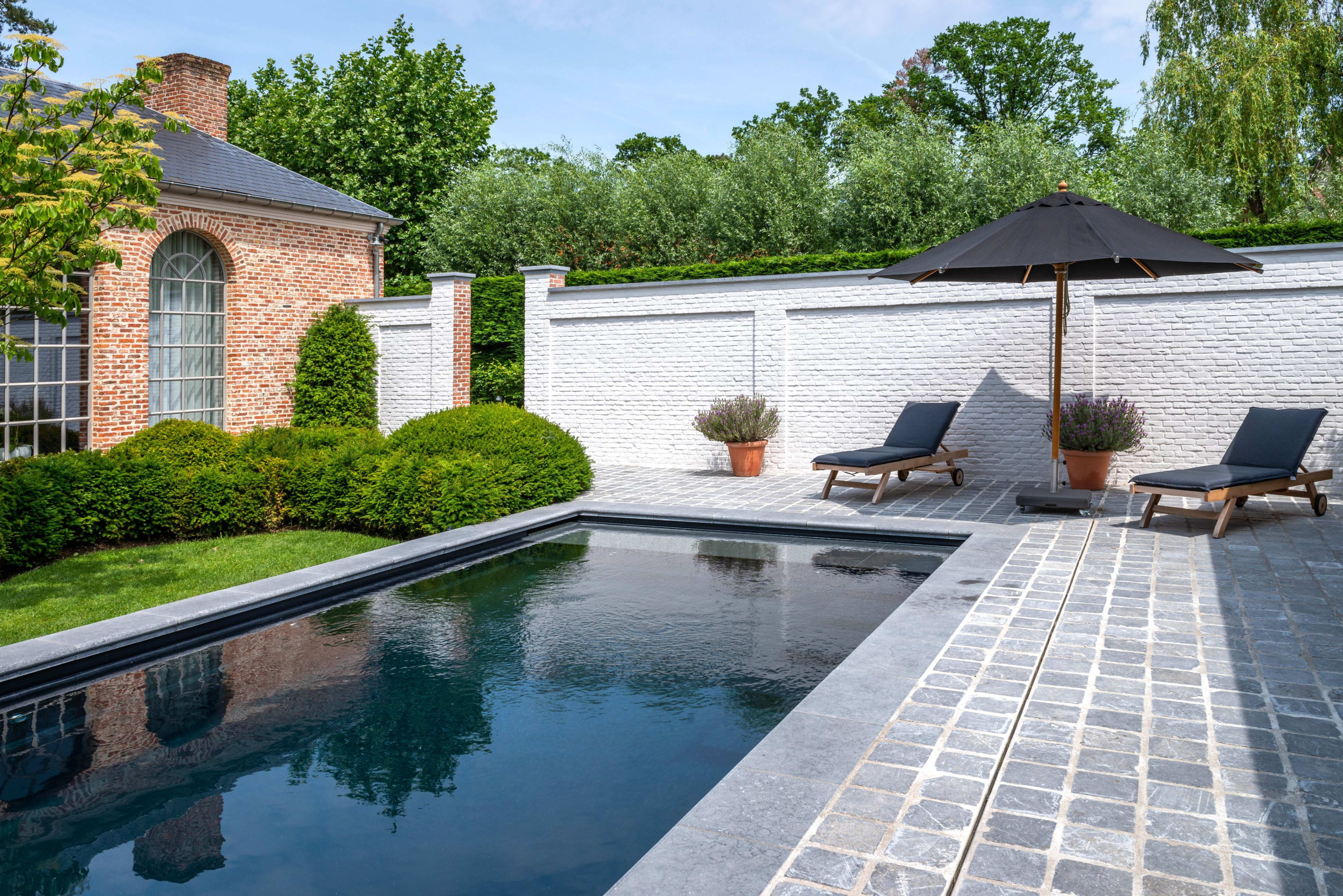
Swimming Pool or Landscaping First?
 Written byFilip De Weer — CE0October 25, 2026
Reviewed by: Leisure Pools Technical Team
Last reviewed: October 25, 2026
Plan pool and garden together, but usually finish the pool before landscaping the terrace, lawn and planting. This avoids damage, rework and extra costs.

Why the order of works determines budget, access and finishing
The order of works determines much more than just the planning. Installing a swimming pool often requires heavy machinery, soil removal and material transport, and these can later damage paving, lawn or planting that are already finished. At the same time, the pool's position helps determine how terraces, sightlines, privacy and walking routes come together logically in the garden. The technical set-up should not be left until afterwards either: space for the filter, pipework, a cover and future servicing must be fixed in advance.
The usual order for a swimming pool project
Phase
What happens?
Why in this order?
Design and preparation
Location, dimensions, levels plan, drainage, technical set-up, permits and site access are coordinated.
This ensures the pool and garden will work together instead of blocking each other.
Earthworks and installation
Excavation, sub-base, delivery and installation of the pool.
These are the heaviest site phases and therefore the biggest risk to finished garden areas.
Technical connections
Pipework, filtration, electricity, water and any extras are connected and tested.
The technical set-up must be correct and accessible before the finishing is put in place.
Final landscaping
Terrace, paths, lawn, planting and detail finishing around the pool.
It is best to wait with fine finishing until the rough site work is fully behind you.
Rough levelling or preparatory garden works can sometimes run in parallel, but the step-by-step plan for your swimming pool project usually stays the same: first the structural work, then the finishing. The exact timing depends on the type of pool, access to the plot and the chosen technical set-up.
When some landscaping can already be done earlier
- What can safely be done early: the overall design, surveying, checking permits, the levels plan, the drainage plan and coordination between the pool builder and the landscaper.
- What can sometimes already be done: rough levelling outside the actual site and delivery zone.
- What is better to postpone: final terrace finishing, lawn, delicate planting, irrigation and decorative areas along the access route.
- What must always remain clear: space for an excavator, crane, material storage and removal of excavated soil.
Which decisions shape the planning
In practice, three factors determine the order of the works: the location of the pool, the technical design and the rules or constraints of the plot. Ideally, those choices are fixed before the works are scheduled, so that pool construction and landscaping do not literally get in each other's way.
Location, sightlines and site access
A pool closer to the house is often convenient for daily use, supervision and the connection to the terrace. Further into the garden can in turn offer more peace or privacy, but usually means longer walking routes and extra attention to the technical set-up and maintenance. Sun orientation, overlooking from outside, the view from the house and the position of paths or seating areas are best considered together. Do not forget the site either: the most attractive spot on the plan is not always the smartest one if machines or a crane can hardly reach it.
Plan the technical set-up, pipe runs and drainage in advance
Before terraces and garden paths are finally laid, it must be clear where the pump, filter, technical room, electricity, water supply and any heating or cover will go. The pipe routes and drainage should also already be on the plan by then. If those choices are made only later, paving often has to be opened up again. Think beyond handover too: technical equipment that works today but is hard to reach tomorrow will sooner or later mean the garden has to be broken open again.
Do not underestimate permits, levels and plot constraints
Before you fix the order of works, it is wise to check local rules, dimensions and distance to plot boundaries. Level differences, ground conditions or limited access can also make extra earthworks for a swimming pool, drainage or retaining walls necessary. Such constraints often determine whether certain parts of the landscaping can already start, or are better left until the pool is fully installed and technically ready.
Common mistakes when the garden is finished too early
- Installing the terrace and coping stones around the swimming pool before pipework, the technical set-up and drainage are fully finalised.
- Sowing the lawn or placing delicate planting in places where machines, cranes or soil transport will still pass later.
- Forgetting to allow space for technical equipment or servicing, so that paving has to be opened up again later.
- Extra costs due to re-levelling, repair of the finishing, additional transport and delay on site.
Practical questions that often come up
Besides the order of pool construction and landscaping, a few practical questions also come up regularly. Below you will find short answers, each considered from the perspective of planning, installation and use.
How can I build my own swimming pool in my garden?
Even with self-build, the logic stays the same: first the design, location, permits, levels plan and technical set-up, and only then the earthworks, installation and finishing. A permanent in-ground pool requires precise excavation, stable installation, drainage and correct connections. Anyone who builds it themselves and works out the site access, levels or technical provisions too late is more likely to run into costly corrections. Doing it yourself therefore does not change the order; it makes good preparation even more important.
Is a swimming pond cheaper than a swimming pool?
There is no universal answer to that. Size, earthworks, finishing, filtration method and the way the project is integrated into the garden all help determine the total cost. A swimming pond often requires a different spatial approach from a traditional swimming pool, which also has consequences for installation and long-term maintenance. So do not compare only the purchase or initial installation, but the full picture of space use, finishing and later care.
How can I drain my Intex pool?
That depends on the specific model and on the drain outlet or hose connection provided by the manufacturer. So always follow the manual for your Intex pool. Also, do not simply let pool water run off where it could cause nuisance or damage. This is also a different situation from that of a permanent in-ground pool and is separate from the order of pool construction and final landscaping.
Is your house worth more with a swimming pool?
A swimming pool can increase the appeal of a home, but there is no automatic increase in value. The location, practical value, maintenance burden and quality of the finishing all play a role. A swimming pool that is technically awkwardly positioned or poorly integrated into the garden can even limit that practical value. That is why thoughtful integration and the order of works matter more than relying on the pool alone as a value driver.
Ready to start building your dream swimming pool?