
Drainage around a swimming pool
 Written byFilip De Weer — CE0November 17, 2026
Reviewed by: Leisure Pools Technical Team
Last reviewed: November 17, 2026
Drainage Around a Swimming Pool: Slope, Channels & Drains
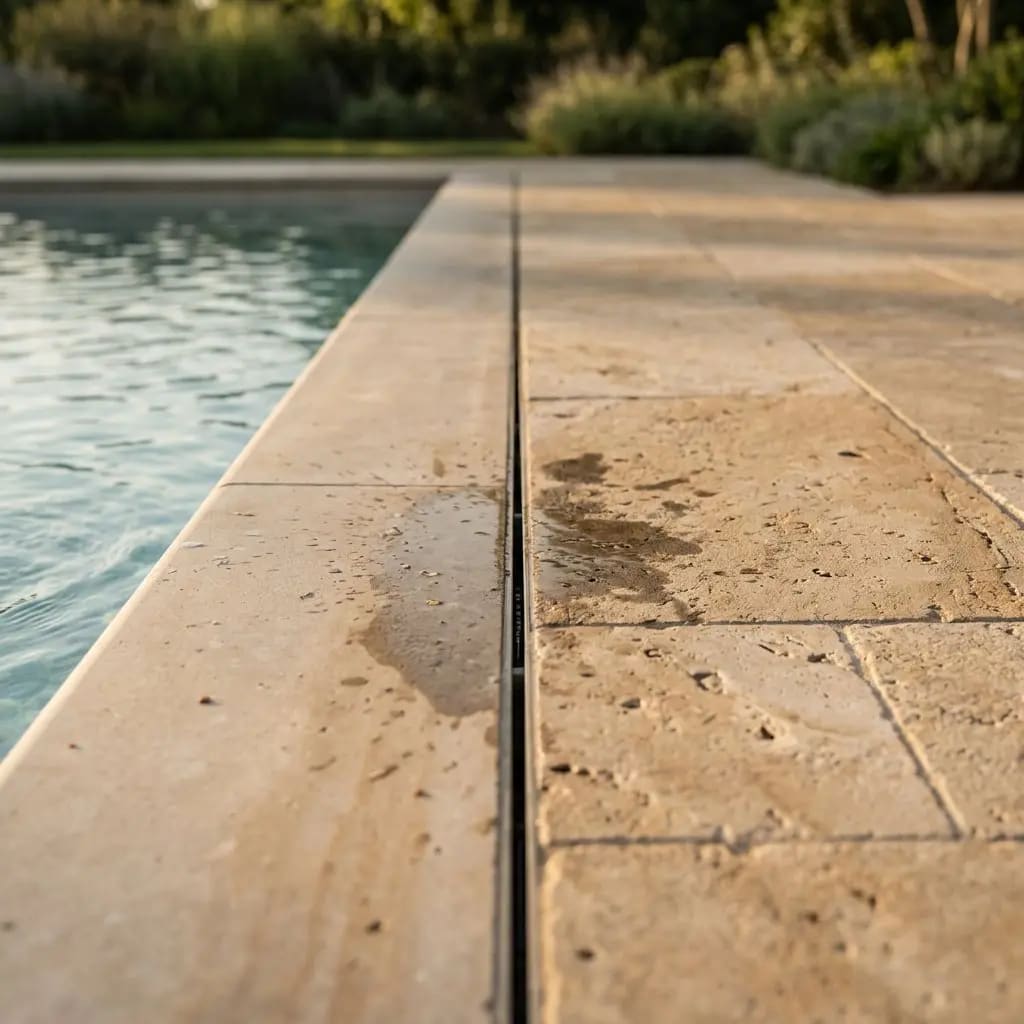
Good drainage around a swimming pool does more than prevent puddles. It improves safety, keeps walking areas comfortable and protects the terrace, coping stones and sub-base against prolonged moisture exposure.
Around the pool, rainwater, splash water and water from wet feet must be able to drain away in a controlled way. Otherwise, slippery surfaces, green deposits and dirt can end up back in the swimming pool.
The right solution depends on the slope, the terrace finish, level differences such as with a swimming pool in a garden with a level difference, and on the point at which you include drainage in the construction plan.
Why standing water around your swimming pool causes technical problems
Water around a swimming pool comes from several sources: rain on the terrace, splash water along the coping, bathers stepping out of the water and local low points in the paving. If that water remains in place, slippery areas, green deposits and extra contamination in the pool develop more quickly. Good drainage therefore protects not only the appearance, but also the structural build-up. A channel drain around the entire swimming pool is far from always necessary; the low points and the site conditions determine the solution.
Which drainage solution best suits your terrace?
The most commonly used solutions mainly differ in application, comfort and integration into the finish.
Solution
Best suited to
Points to consider
Linear channel drain
Large terraces or a long, straight lowest edge
Choose a low-maintenance grating that is comfortable for bare feet and looks visually understated
Point drain
Local low points, steps, outdoor showers or renovations
Must be positioned exactly at the actual lowest point
Gravel or infiltration strip
A natural transition to the garden or green area
Only suitable if the ground build-up and rainwater plan allow it
Slope with discreet drains
Sleek premium terraces with very little visible drainage
Requires precise levels, thoughtful material choices and good distribution of drainage points
Rainwater and splash water should be connected to the wider rainwater plan, not to the swimming pool installation.
How to technically align slope, coping stones and the terrace
A swimming pool terrace does not need a steep slope, but it does need to be consistent everywhere. With a subtle slope, you guide water away without compromising walking comfort or the appearance of terrace and coping stones around the swimming pool. The coping stones, terrace level and adjoining garden areas must be designed as one whole. Pay extra attention to steps, outdoor showers and transitions between paved surfaces: that is where water collects fastest and wet, slippery areas often develop.
These mistakes cause puddles, slippery surfaces and subsidence later on
Many problems that appear later are caused by design errors. With a swimming pool in an area with high groundwater, drainage and the sub-base are also more likely to go wrong:
- an almost level terrace or a slope in the wrong direction;
- too few drainage points, or not at the true lowest points;
- only adding drainage after the swimming pool or terrace design;
- a poor drainage route or unstable sub-base, resulting in saturation, frost heave or settlement.
Include drainage in the design and construction process from the start
Drainage works best when it is developed at the same time as the pool position, terrace layout, garden levels and the groundworks for a swimming pool. This ensures that the pool builder, groundworks contractor and garden contractor are technically aligned. Also distinguish between rainwater and splash water around the pool on the one hand, and maintenance water, backwash or drain-down water on the other: they do not automatically follow the same drainage logic. At Leisure Pools Benelux, such choices are therefore already taken into account early in the technical preparation of the swimming pool project.
Frequently asked questions about a swimming pool project
What is the 10-20 rule in a swimming pool?
No. The 10-20 rule is not a standard for drainage around a private swimming pool. The term is sometimes used informally in other pool contexts, such as usage or maintenance advice, but not as a technical guideline for terrace slope or drainage. For construction around the pool, levels, low points, the sub-base and the drainage route are decisive. That rule has no direct influence on those aspects.
What is the best cover for a swimming pool?
There is no universally best cover. An automatic cover offers a great deal of ease of use, insulation and clean integration, but requires built-in provisions at an early stage. A bar cover is practical and robust, while a seasonal or winter cover mainly protects the pool when it is used less. The choice also affects edge details, storage options and water behaviour around the coping and terrace.
How many litres does a normal swimming pool hold?
You calculate the volume using length x width x average depth x 1,000. A normal family swimming pool therefore usually holds several tens of thousands of litres, often roughly between 30,000 and 60,000 litres. That volume has a direct impact on water treatment, heating and on the amount of water you need to manage in a controlled way during overflow, draining or maintenance.
What is better: a round or a square swimming pool?
That depends on your use and design. A round swimming pool fits nicely into an organic garden, but a square or rectangular shape often uses the space more efficiently. Straight lines generally combine more easily with covers, coping stones, linear terraces and discreet drainage solutions. The best choice therefore follows from the available space and the overall vision for the garden, terrace and swimming pool.

Ready to start building your dream swimming pool?


